
Supreme Court Considers Limits of Presidential Power
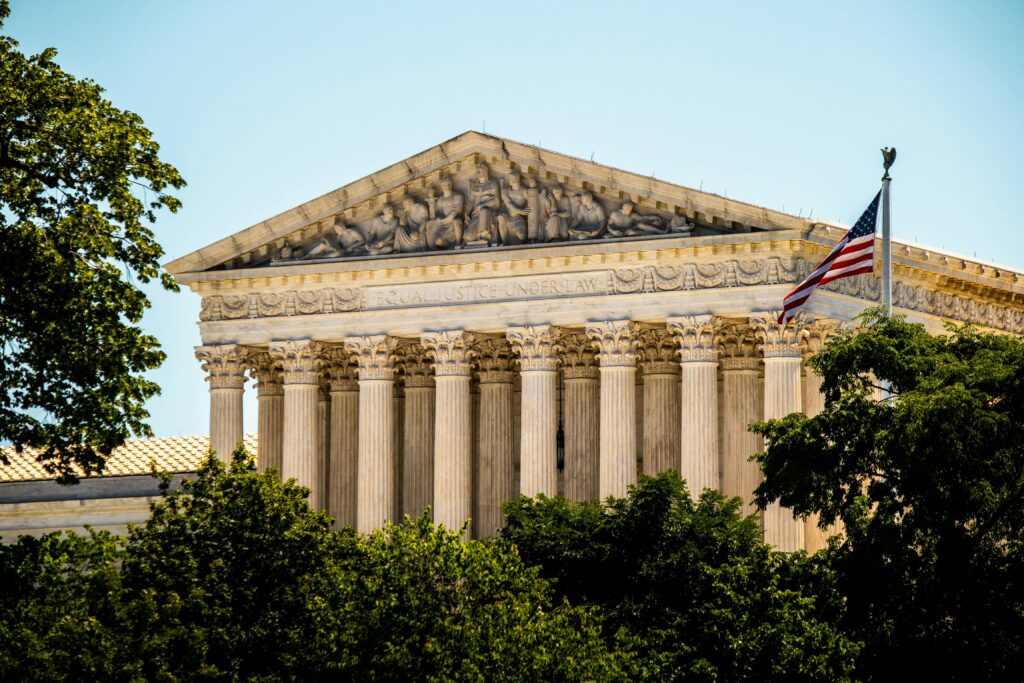
Jimmy Woo, Unsplash
The Supreme Court is currently deliberating on a case with the potential to reshape the balance of power within the U.S. government.
The case, Trump v. Slaughter, centers on the president’s authority to remove the heads of independent federal agencies without cause. This legal battle stems from President Donald Trump’s firing of Federal Trade Commission (FTC) member Rebecca Slaughter, a move that challenges nearly a century of established legal precedent and forces a direct examination of the president’s executive power.
At its core, the dispute tests the constitutional separation of powers and the structure of the administrative state that oversees vast sectors of the American economy.
The Court’s decision will not only resolve the legality of Slaughter’s termination but will also set a new standard for the relationship between the White House and the numerous agencies designed to operate with a degree of independence.
The arguments presented have revealed a deep ideological divide on the bench, with implications that extend far beyond the FTC.
Challenging a 90-Year-Old Precedent
The legal foundation for the case is the 1935 Supreme Court decision in Humphrey’s Executor v. United States. That ruling established that Congress could set statutory limits on a president’s ability to remove commissioners of certain independent agencies, allowing termination only for specific reasons such as “inefficiency, neglect of duty, or malfeasance in office.”
This protection was designed to insulate these agencies from purely political pressure and allow them to carry out their regulatory and quasi-judicial functions impartially.
Rebecca Slaughter, a Democrat whose term at the FTC was not set to expire for several years, sued the president after her termination, arguing it directly violated the protections established in Humphrey’s Executor.
Her legal team contends that overturning this long-standing precedent would radically destabilize the institutions that have become integral to the fabric of American governance. They argue that these agencies, from the Securities and Exchange Commission to the National Labor Relations Board, rely on their independence to function effectively.
The Trump administration, however, views the matter through a different constitutional lens.
U.S. Solicitor General John Sauer, arguing on behalf of the president, described Humphrey’s Executor as a “decaying husk” and an “indefensible outlier.”
He asserted that such limitations on presidential removal power unconstitutionally infringe upon the authority granted to the president under Article II of the Constitution to oversee the executive branch.
A Clash of Constitutional Interpretations
During oral arguments, the justices rigorously questioned both sides, exposing the fundamental conflict in their constitutional interpretations.
The administration’s argument is rooted in the unitary executive theory, which posits that the president must have sole authority over the executive branch to fulfill the constitutional duty to “take Care that the Laws be faithfully executed.”
Sauer argued that allowing agency heads to remain in their positions against a president’s wishes creates a “headless branch” of government unaccountable to the elected chief executive.
Justice Neil Gorsuch engaged in a pointed exchange with Slaughter’s attorney, Amit Agarwal, pressing him on whether the president has a duty to faithfully execute all the laws. When Agarwal hesitated to give a simple “yes,” suggesting that the “take care” clause does not automatically grant at-will removal power, Gorsuch highlighted the apparent contradiction.
Gorsuch suggested that this complex legal theory might be an attempt to “back-fill” what he described as the “poorly reasoned” foundation of Humphrey’s Executor and its creation of “quasi-judicial and quasi-legislative” bodies.
In response, Slaughter’s counsel warned of a slippery slope, arguing that a victory for the administration would put all independent agencies “on the chopping block.”
Agarwal emphasized that multi-member commissions with removal protections have been a part of the government structure for decades, and that dismantling this system would have profound and unpredictable consequences.
He urged the Court to respect the collective experience of all three branches of government that has supported this structure for nearly a century.
The Battle Over Executive Power
This is not just a legal debate, it’s a fight for who commands the vast machinery of government. Some on the high court, like Justice Jackson, have staked out a position: stripping the president and the executive office of the power to fire and cut back the unchecked bureaucracy, what many now call the deep state.
SCOTUS: Justice Ketanji Brown Jackson told the Court that presidents should not be able to fire the PhDs & experts who run the government. She even argued that presidents should avoid control over transportation & the economy.
In a remarkable exchange in Trump v Slaughter, Justice… pic.twitter.com/sXQesOSdKG
— @amuse (@amuse) December 8, 2025
The question is urgent and personal for every American: If not the president, a leader chosen by the people, then who holds the power over our national destiny? Article II of the Constitution explicitly places the powers of the executive, including the right to hire and fire those who direct our nation’s agencies, squarely in the president’s hands.
Nowhere does the Constitution hand these powers to unelected managers or distant bureaucrats. Justice Jackson’s view attempts to blur the lines of accountability without providing a true solution or a safeguard for the people’s voice.
This battle is about restoring accountability, protecting liberty, and ensuring that We the People, through our elected leaders, hold the reins of power.
The Justices’ Reactions and Potential Ramifications
The justices’ questions and comments during the nearly three-hour session revealed a court grappling with the weight of overturning a major precedent.
The Court’s liberal wing expressed significant concern about the potential fallout. Justice Sonia Sotomayor told the administration’s lawyer, “You’re asking us to destroy the structure of government,” while Justice Elena Kagan warned, “Once you’re down this road, it’s a little bit hard to see how you stop.”
Conversely, the conservative majority appeared more receptive to the administration’s arguments about presidential authority.
Chief Justice John Roberts noted that the FTC of today wields far more executive power than the agency that existed in 1935, suggesting the original reasoning for Humphrey’s may no longer apply.
Justices Brett Kavanaugh and Amy Coney Barrett explored a more middle-ground approach, questioning what “limiting principles” could be applied if the court were to narrow the 1935 precedent without overturning it completely.
The outcome of Trump v. Slaughter will have sweeping implications regardless of how the Court rules.
A decision in favor of the president would dramatically centralize power in the executive branch, allowing a president to immediately reshape the leadership of agencies that regulate everything from financial markets to labor practices and consumer protection.
Such a move would be celebrated by those who seek to rein in the administrative state but criticized by others as a dangerous erosion of institutional stability and a move toward unchecked executive power.
The Court’s final decision, expected by the end of June 2026, will be a landmark moment in the ongoing debate over the scope and limits of presidential authority.
Contacting your representatives should be easy, but there are myriad ways they can ignore your messages. That’s where we come in.
Yes, Million Voices helps you with voter guides. Yes, we send letters from YOU directly to your elected officials because it’s the only way to guarantee they’ll listen to you. Yes, we publish data, articles, text messages, and help bridge the gap between education and civic action. But what do you want? Tell us today.
We want to make YOU the hero of our American story by giving you the tools you need to make a difference, from your local, state, all the way up to the federal level.
Join us in our mission to advocate for religious freedom, support fair and secure elections, and uphold the values that this great nation was built upon. Tell us what you want from the next four years, and we will fight to make it a reality … again!
Share on these platforms:
Million Voices is a movement that gives voters and potential voters the foundation they need to confidently act from a biblical worldview.